
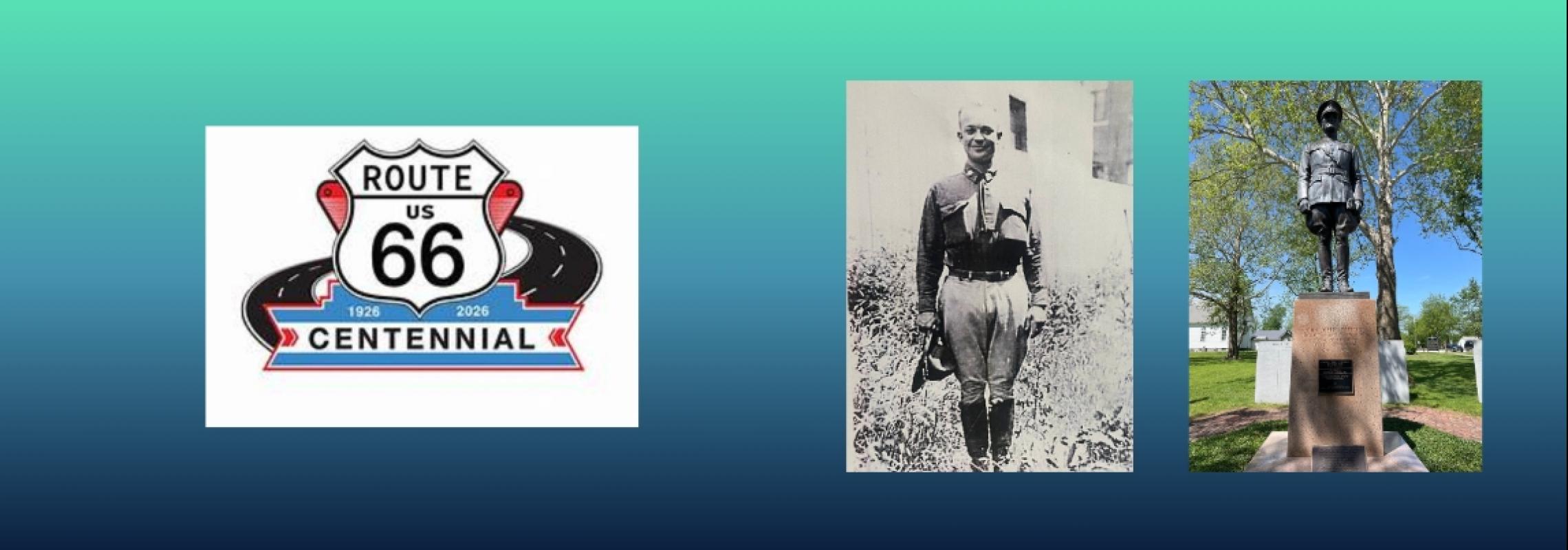
Part of the series, "100 Years on Route 66 in 52 Weeks," published by the Missouri Press Association and distributed for reprint by its membership newspapers. Reprinted here with permission by MPA.
By Bob Ford
For mankind to advance, we have to be able to move. From a path to trail, dirt roads to interstates, the ability to hunt, trade, transport, relocate and defend oneself is freedom. Route 66 became the All-American highway that provided those sustaining abilities, but it also added an eclectic cultural element.
How did this important mixture of iconic highway and personal passageway to a better life come to be?
Gen. John J. Pershing wasn’t happy. He and his American Expeditionary Force had just led the Allies in defeating Germany and the Axis Powers in World War I. It was a brutal war that brought much of Europe to its knees, which is why England and France pressured Pershing into accepting an Armistice instead of pressing on for an unconditional surrender.
“The general wanted to invade, then occupy Germany and dismantle their war machine,” said Danzil Heaney, director of the John J. Pershing Boyhood Home State Historic Site in Laclede, Missouri. Because of the way peace was achieved, Pershing predicted another world war in 30 years. He was close − Germany attacked Poland 21 years after the Armistice. The Missouri-born 6-star general also knew the United States would not be prepared for the new kind of mechanized war that was coming.
The ability to move troops and supplies would be paramount. Pershing, sensing urgency, in 1919 ordered an 81-vehicle convoy to go coast to coast to expose America’s highway “pitfalls.” Young Lt. Colonel Dwight D. Eisenhower joined the caravan “partly as a lark and partly to learn,” he later wrote. The “train” consisted of 24 officers and 258 enlisted men driving 34 heavy cargo trucks, four delivery trucks, two mobile machine shops, water trucks, gasoline trucks, eight touring cars, nine motorcycles, and a partridge in two ambulances.
The convoy left the East Coast in July 1919 on the 3,200-mile odyssey with several Corps represented: Air Service, Coastal and Field Artillery, Medical, Ordnance, Signal and Tank. It took 56 grueling days to get from Washington, D.C. to San Franscisco. The eastern part of the trek was fairly uneventful, but roads and bridges west of Illinois were atrocious − no pavement, huge ruts, deep pits and dilapidated wooden bridges. Engineers had to inspect, then fortify or detour around those crumbling structures daily to keep the caravan moving. Vehicles would get stuck in knee-deep mud whenever it rained, but luckily the equipment to pull them out was just down the line.
Throughout the rural countryside and in small towns, this was the likes of a military parade people had never seen. The “train” had two public relations officers driving a day ahead, giving towns a heads-up on what was coming. Many places greeted the convoy with a parade of their own, led by firetrucks and local dignitaries.
It is estimated the column rolled through a hundred towns and was cheered on by three million Americans.
In Eisenhower’s final report, he not only called it an “absolute military necessity for reliable roads and bridges,” but went on to describe construction standards that would become federally mandated. Who knows how this experience influenced the future president in developing the interstate system we all enjoy today, but you know it had to.
Military roads aren’t new. During the greatest peacetime migration the world had ever seen, in the mid-1800s, forts on the U.S. frontier protected and sheltered hundreds of thousands of settlers heading west along the Oregon, California, Mormon, and Santa Fe trails among others. Fort Snelling in Minnesota through Ft. Leavenworth and Ft. Scott in Kansas to Fort Gibson in Oklahoma were connected by military roads with the ability to move troops and supplies, protecting the vast new territories the best they could with the men and material they were given.
Buffalo soldiers, ex-Civil War soldiers, settlers, gunfighters, farmers, dandies, drunks, Native Americans and painted ladies were all part of the American frontier fabric who ventured west for a myriad of reasons.
Route 66 was one of the first federal highways to benefit from Ike’s exploits. Meandering over 2,000 miles connecting 3.3 million Chicagoans and 1.2 million basking-in-the sun Angelenos, for many decades the highway represented a pipeline for anyone seeking a different future.
Eisenhower wasn’t the only one who realized the military importance of constructing a national reliable highway system. Hitler became chancellor of Germany in 1933 and built the Autobahn, giving him the road network needed to quickly deploy military assets while providing work for his post-World War I, starving and humiliated people. Not sure if the words Hitler and Route 66 were ever used in the same story before, but there you go! The byproduct in times of peace of course is to see these strategic byways used for commerce, pleasure and allowing anyone the liberty to pursue a better life.
With all considered at the end of the road, we must say, “Thank you, Ike!”
Bob Ford is a syndicated history/humor writer from St. Joseph. You can find more of Bob’s work on his website, bobfordshistory.com, and videos on YouTube, TikTok and Clapper. He can be contacted at Robertmford@aol.com.