
Part of the series, "100 Years on Route 66 in 52 Weeks," published by the Missouri Press Association and distributed for reprint by its membership newspapers. Reprinted here with permission by MPA.
By Jim Hinckley
William Clay Pierce of the St. Louis-based Pierce Petroleum Company envisioned a nationwide chain that would provide lodging and dining as well automotive services and transform the road trip. This would be accomplished by linking Pierce-Pennant gas stations with standardized motor hotels and restaurants. The Harvey House hotel properties with railroad depots established by Fred Harvey would serve as a template. The first phase of the ambitious project was to establish Pierce Pennant Motor Hotels along U.S. 66 approximately every 125 miles between Chicago and Los Angeles. Complexes along the highway between St. Louis and Jefferson City were also planned.
In July 1928 the company opened the first Pierce-Pennant Motor Hotel in Rolla. That was followed by construction of a complex in Springfield that included a bus terminal, restaurant with soda fountain, clean restrooms, and a gas station with garage and car wash. Over the course of the next 18 months complexes were built in Pond (now Wildwood), Columbia, Tulsa, and Miami, Oklahoma. An article published on July 21, 1929, in the Miami News-Record provides interesting details about these innovative properties. “Construction of a 40-room tourist hotel as the second unit of the Pierce Petroleum corporation’s development two miles north of Miami on U.S. Highway 66 will be started late this year, according to information received from the corporation’s headquarters in St. Louis. The structure will cost approximately $300,000, it is understood. Similar projects are under construction in Columbia, Mo., and in Oklahoma City and Tulsa. Key buildings have been completed in Springfield and Rolla, Mo. When finished the chain will extend the length of Highway 66, according to T.W. O’Donnell, Oklahoma City district manager. Development of the chain follows the success of the first hotel built in Rolla, Mo., O’Donnell said.”
The May 11 issue of Tavern Talk, a hotel trade magazine of the period noted that, “Each Pennant terminal will have a complete restaurant, restrooms for men and women, emergency hospital, lounge, and refreshment facilities, in addition to complete service station equipment. Close to $1,000,000 will be spent in the development of Pennant terminals this year, building comforts for the American tourist, with the expectation of materially increasing the construction budget in 1930.” The article described in detail the amenities envisioned. It is evident that the company was planning a quantum leap in roadside lodging and services.
“In the center of the 10 landscaped acres is to be constructed the terminal building. The hotel units being built by the corporation will be far ahead of anything ever constructed for tourist use and will be equal to or better than the modern hotels in the larger cities. The building is fireproof throughout. The furniture and equipment in the guest rooms will be above that of the average hotel in the large cities. The bathrooms will be floored with rubber tile, lined with white tile, and equipped with hot and cold water tub and shower. Both bedrooms and bathrooms will be equipped with an electric fan. The springs, mattresses, linens, towels, blankets, carpets, draperies, etc., will be equal to the better hotels in the large cities. In the basement of each terminal building is a modern steam laundry for laundering the linen of the terminal and hotel buildings. This laundry will work nights and tourists delivering their laundry to hotel employees before 9 p.m. can have it returned to them any time they desire after 4 a.m. the next morning.”
The Pierce-Pennant Motor Hotel chain was a grand idea. But the willowing winds of the Great Depression decimated the nation’s economy and brought Pierce’s dream to an end. In 1930, the Sinclair Refining Company acquired many assets including properties from the Pierce Petroleum Company. A few of the Pierce Pennant Hotel complexes were rebranded as Sinclair-Pennant Hotels and the rest were sold. The Pierce Pennant Hotel in Columbia was added to the National Register of Historic Places in 1982. During WWII it was used to house female navigators and aviators who were training at Stephens College. In post-war years most of the complex was razed and only the hotel renamed Candlelight Lodge remained. For more than 60 years it served as a senior citizen housing complex. It is currently closed.
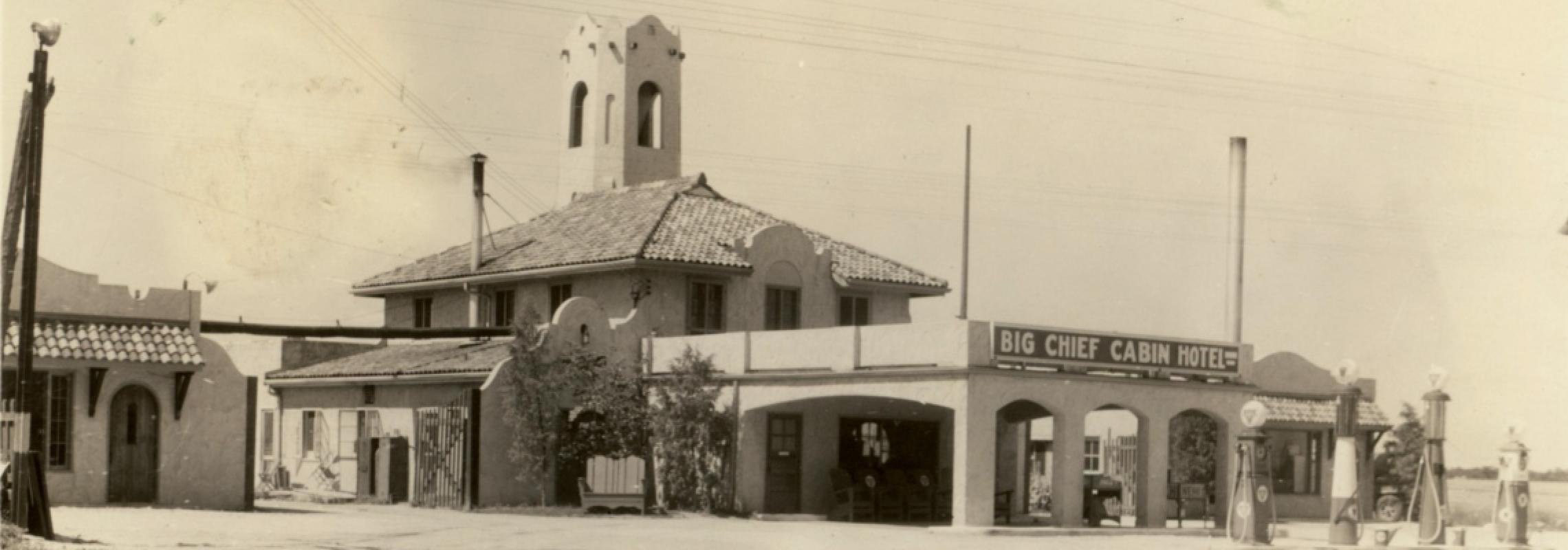
This leaves the Big Chief Roadhouse on Manchester Road, once an alignment of Route 66, in Wildwood as a tangible link to Pierce’s vision. The Big Chief Roadhouse opened in 1929 as the Big Chief Hotel, a sprawling “tourist court” with 62 modern cabins that offered private garages as well as hot and cold running water. To put the size of the complex in context, in 1935 a tourism guide to the Missouri listed only nine courts with more than 30 cabins. The complex also included a full-service restaurant housed in a two-story Mission Revival-style building, a gas station and general store, playground and recreation areas, and a dance floor.
The Great Depression and the collapse of Pierce Petroleum Company were the first blows. Route 66 was realigned in 1932 and business at the Big Chief Hotel complex declined precipitously. A period of opening and closing followed, and in 1946 the restaurant was remodeled. It then opened as Mike Aceto’s Café 66. During World War II the cabins provided housing for employees at nearby factories. After the war they were used as weekly or long-term rentals. The cabins eventually fell into disrepair and were demolished. The original false bell tower that once crowned the restaurant building was removed in the 1950s. The restaurant was repurposed and served as a store front, and later as offices for a landscaping company. Then in 1995, the former Big Chief Hotel restaurant, now the Big Chief Roadhouse, reopened. In 2003 it was listed on the National Register of Historic Places.
Jim Hinckley is the author of 23 books including The Route 66 Encyclopedia, Ghost Towns of Route 66, and Murder and Mayhem on The Main Street of America: Tales from Bloody 66. Sharing America’s story and inspiring road trips by telling people where to go is Jim's passion and the foundation for Jim Hinckley’s America − www.jimhinckleysamerica.com − a multifaceted network that includes a Facebook page, YouTube channel, website, Instagram, and the weekly Coffee With Jim podcast that is designated an official Route 66 centennial program. He can be contacted at jimhinckley@jimhinckleysamerica.com.