
Part of the series, "100 Years on Route 66 in 52 Weeks," published by the Missouri Press Association and distributed for reprint by its membership newspapers. Reprinted here with permission by MPA.
By Cheryl Eichar Jett
St. Louis’s coal smoke pollution in the early 1900s threatened the delicate orchids at the Missouri Botanical Garden, prompting the Garden’s trustees to purchase land for an arboretum outside of the city. Danish horticulturist Lars Peter Jensen developed the arboretum and managed the huge project of landscaping the Henry Shaw Gardenway along Route 66 on its 30-something-mile path from the Botanical Garden to the Shaw Arboretum, leaving a legacy to complement Shaw’s.
Black Tuesday
St. Louis residents woke up on the morning of Nov. 28, 1938, to a soot-filled black smog blanketing their city. Known afterward as Black Tuesday, the day was considered to be the worst of many, the result of soft “dirty” coal heating homes and businesses and powering locomotives. It was said that the average resident ingested 15 tablespoons of soot over every five-day period.
Meanwhile, at the Missouri Botanical Garden, director George T. Moore and his staff worried about the effects of the heavily-polluted air on the trees and plants. However, precautionary steps had been taken, beginning in the early 1920s. The Botanical Garden’s collection of orchids had been moved to the new Shaw Arboretum at Gray Summit, safely out of the dense smog in the city.
Henry Shaw and the Missouri Botanical Garden
Henry Shaw was a successful businessman in the early 1800s in St. Louis. Shaw never married and did not live extravagantly, enabling him to purchase a considerable amount of real estate in and just outside of the growing city. He was particularly intrigued with a tract of prairie land where he later established Tower Grove Park and the Missouri Botanical Garden.
In 1839, Shaw retired and spent most of the next decade in Europe, although during the last several years of his travel, his staff was busy overseeing work on his favorite piece of property. Prominent architect George I. Barnett had designed a two-story Italian villa-style home which was constructed on the property. Back home after his final trip to Europe, Shaw moved in and began planning his garden, planting thousands of shrubs and trees on the 88-acre tract. In Europe, Shaw had consulted with botanical experts who encouraged him to turn his property from a private to a public garden. Shaw listened and became convinced to do just that. He built a library and a herbarium and a building to house them, and opened the garden to the public in 1859.
During the next three decades, he expanded the garden and its species of plants, built additional buildings and a mausoleum, and established the Henry Shaw School of Botany at Washington University. Shaw died in 1889. His will established the Botanical Garden as a charitable trust. An intensely private man, he had specified that the name “Missouri Botanical Garden” always be used, but, despite his efforts toward privacy, Shaw was a very well-known person in St. Louis, and the popular name “Shaw’s Garden” persists to this day.
The Shaw Arboretum
As the Botanical Garden continued to grow in stature, the city’s appetite for cheap coal to stay warm through the cold Midwestern winters continued to grow as well. The soft “dirty” coal was plentiful and readily available from the mines across the river in Illinois, and it was cheaper than the hard, cleaner-burning anthracite coal. This led to the dangerous pollution that St. Louis found itself mired in, and prompted the decision at the Botanical Garden to move its precious orchids to the newly-acquired acreage south of the city at Gray Summit.
The move, and the Gray Summit acreage itself, was made possible by the charitable trust put in place by Shaw. The trust was written to cover almost any eventuality encountered by the trustees, but a request to the Circuit Court of the City of St. Louis was necessary to sell off some land holdings between Alfred Avenue and Kingshighway in order to purchase the land south of the city at Gray Summit. Approximately 1,600 acres consisting of five farms including the historic Joseph H. Bascom house were acquired. In 1922, Lars Peter Jensen became the first manager of the Shaw Arboretum. Jensen had received an education in horticulture in Copenhagen before coming to the U.S. to work as the landscape architect for various properties of the Adolphus Busch family, including Grant’s Farm.
The Henry Shaw Gardenway
In 1933, the Henry Shaw Gardenway Association was formed to widen the right-of-way along U.S. Highway 66 into a 200-foot parkway landscaped with trees, shrubs, and flowers, and to develop recreational areas along the highway. It was also an opportunity at last to honor Shaw by affixing his name to the Shaw Arboretum, or “Shaw Extension,” as it was commonly called. Jensen was appointed manager of the Gardenway beautification project and named president of the Gardenway Association when it was created. Jensen and John Noyes, a landscape architect at Missouri Botanical Garden, designed the landscaping. In just its first year, the Association planted over 10,000 trees.
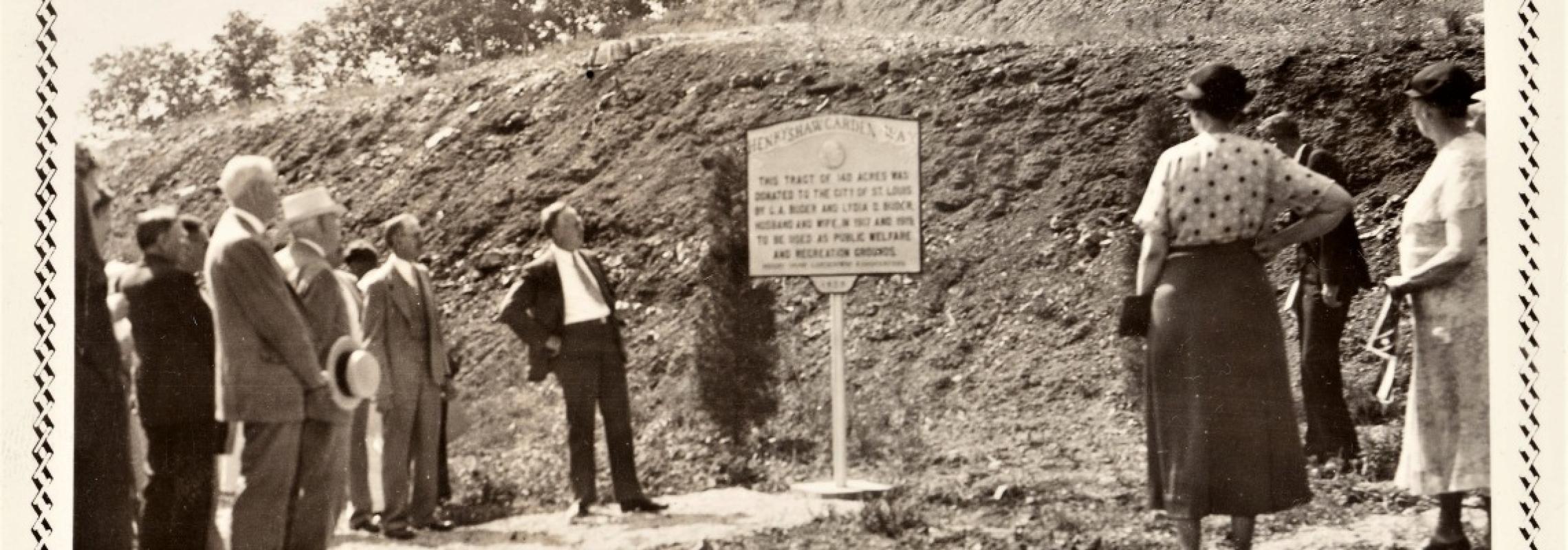
Two years later, in May 1935, ceremonies were held to dedicate the Henry Shaw Gardenway, “the stretch of Highway on U.S. Route 66 from Lindbergh Boulevard to Shaw’s Garden Arboretum at Gray Summit,” according to the St. Louis Post-Dispatch. A series of markers were unveiled at five points along the route – at Chippewa Street, at the St. Louis city limits, at Buder Park near Allenton, at the bluffs near Pacific, and at the Arboretum.
In 1939, a local Civilian Conservation Corps (CCC) camp #1770 work crew went to work building a stone pavilion at the lookout atop the sandstone bluff which became known as Jensen’s Point. On Memorial Day, a dedication ceremony was held, and marching bands paraded on Route 66 between the long rows of parked cars.
The CCC workers also constructed a stone bus stop near Allenton. It was part of a plan to build multiple bus stops, but the Allenton one was the only one that was constructed. (The bus stop was relocated in 2002 to the Shaw Arboretum, which is now known as the Nature Reserve.)
St. Louis cleans up the coal smoke
Back in the city, St. Louis was known nationally as the city with the worst air pollution. But in the late 1930s, the city created a commission to address the problem. New regulations drastically reduced the amount of soft coal that could legally be burned. Bootleg coal dealers stalked the alleys and Illinois mining communities threatened to boycott St. Louis-manufactured products. But gradually, St. Louisans accepted the new regulations and purchased hard coal or installed natural gas furnaces for their homes and businesses; railroads began to use diesel engines. St. Louis was the first U.S. city to enact regulations “to control urban smoke pollution.” By 1946, coal smoke had been reduced by 75 percent, and the rest of the plant collections at the Missouri Botanical Garden remained there. The Shaw Arboretum “evolved into a showcase of the native plants, wildlife and natural communities of eastern Missouri,” stated an article in Missouri Conservationist.
Development of the Gardenway
In the 1950s, development and activities along the Gardenway, also known as the Henry Shaw Ozark Corridor, continued. Tyson Valley Park was opened with the dedication of a plaque in 1950. In 1953, a remarkable event was held at the Shaw Arboretum. Thirty thousand people attended a three-day event featuring a pageant entitled “The Saga of the Meramec,” which dramatized land use in the Meramec Valley. Eventually, a chain of recreational areas was developed to include Lone Elk Park, the World Bird Sanctuary, the Endangered Wolf Center, West Tyson County Park, and the Forest 44 Conservation Area.
Jensen’s Point reopens
Wayne Winchester, a Pacific area businessman, purchased the Jensen’s Point property in the early 1990s after years of neglect had taken its toll. Winchester was aware of the significance of the overlook atop the sandstone bluff above Pacific, and he worked to repair the pavilion roof and erect some fencing. In 2015, Steve Myers, alderman for the City of Pacific, convinced Winchester to sell Jensen’s Point to the city. The St. Louis County Municipal Parks Grant Commission awarded a grant of $350,000 to Pacific to be used for the purchase and restoration of Jensen’s Point. Additional money came from Great Rivers Greenway and Pacific’s tourism fund. Ozark Trails Association, the Route 66 Association of Missouri, Friends of the Mother Road, and the Indian Trails Chapter Show-Me Missouri Back Country Horsemen provided many manhours for a clean-up day in November 2015.
On Memorial Day 2016, 77 years after the pavilion outlook was originally dedicated, Jensen’s Point was officially reopened and rededicated, with a celebratory crowd attending. The ceremony began at 2 p.m., as did the original ceremony in 1939.
Six miles south of Jensen’s Point is Shaw Nature Reserve, renamed in 2000 from Shaw Arboretum. The 2,400-acre private nature reserve is operated as an extension of the Missouri Botanical Garden. The nature reserve is open year round and features 14 miles of hiking trails, several historic homes, and a wetland blind where water birds can be observed. Both Henry Shaw and Lars Peter Jensen would surely approve.
Cheryl Eichar Jett is the author of the upcoming book Aprons Away: Women’s Work on Route 66, which will be published this spring. She wrote the Illinois chapter for the recently released Route 66: 100 Years, and also has a monthly column covering “Along Route 66 and Beyond” for Prairie Land Buzz, a regional Illinois publication. She can be contacted at cheryleicharjett@gmail.com.
Photo Caption:
The Henry Shaw Gardenway dedication in 1935. (MoDOT)