
By Ashley Weaver
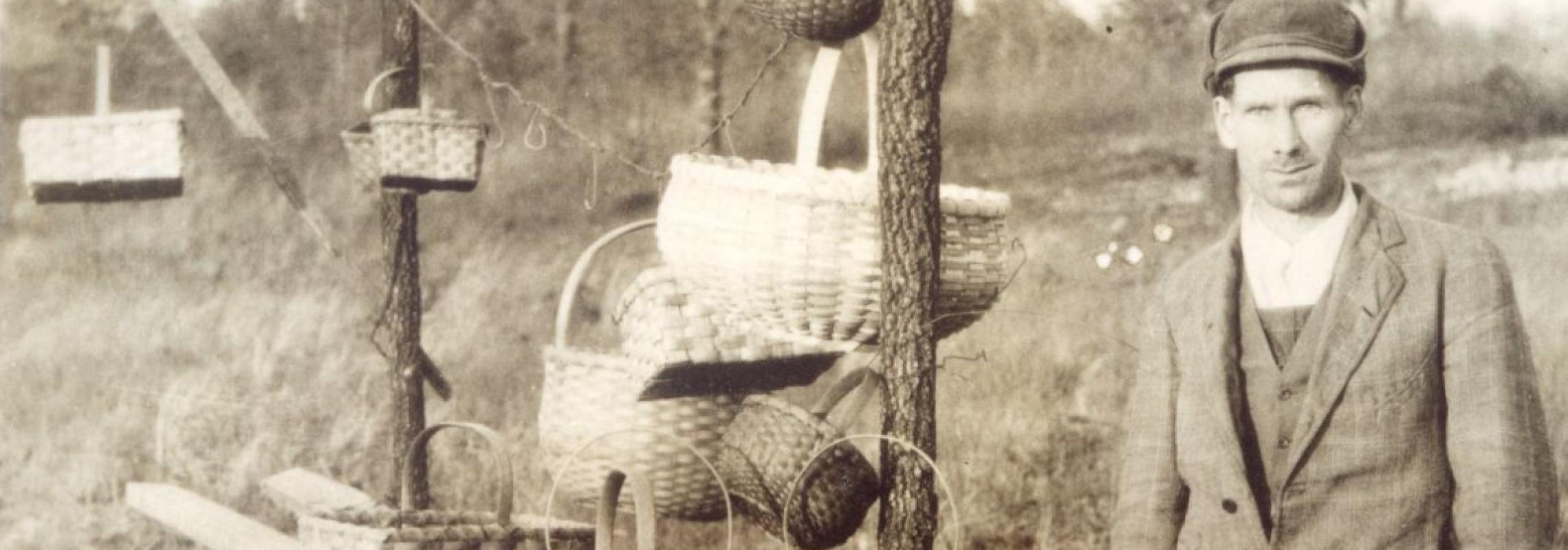
William Francis Childers weaved wooden baskets in the traditional Ozark style and taught others the craft, including his son, Henry J. Childers, owner of Artful Woodwork on Route 66. In addition to selling hand-made baskets, the family sold woven furniture, including baby cradles from white oak strips. The Childers’s daughter, Amy Childers Thompson, remembers the variety of baskets her father and other family members made, “including rounded egg baskets that a farm wife could carry over her arm, and wide flat ones to carry kindling or fruit,” wrote Route 66 authors Quinta Scott and Susan Croce Kelly. Amy’s husband, Harry, also created roosters, hens, chicks, ducks, rabbits, and frogs from a mixture of plaster of Paris in molds he acquired. He painted the animal shapes and sold them to folks traveling the highway.
William Childers married Margaret Elizabeth Arthur in the summer of 1887. They raised eleven children, moving between southwest Missouri and Oklahoma. Their grandson, Elbert Childers, said his family moved from Cabool to the tiny town of Clementine, just off original Route 66 in 1928 because his father, Henry, thought it would be a better place to sell things. The family was well-positioned for selling their wares once the Mother Road came to be.
The Great Depression hit the Ozarks hard in the 1930s. While many folks struggled to make ends meet, the basket-making business held strong. Travelers across the country visited the area known as “Basketville,” which included stops along Highway 66 between Clementine and Hooker, Mo. Thompson said that her family fared better than most people in their area. The Childers even opened a small basket factory near their shop in Clemintine. Custom orders for baskets were made and shipped across the United States. Tourists took photographs of their visits to “Basketville” and often sent copies back to the shops they stopped along the highway.
The successful business of the Childers family led other families in the area to make baskets, too. Stories passed down from descendants suggest that many of the most talented basket makers in the area, including George Miller and Clarence and Raymond Wells, were taught by the Childers elders. Likely, most of the artisans along “Basketville” learned some portion of the trade from Childers family or artisans connected to the Childers’s basket factory.
The Childers family suffered tragedy in 1942. Henry died at the age of 50 from tuberculosis, leaving his six children without a parent. Their mother, Sarah Ann, died from a heart condition seven years earlier, shortly after the birth of your youngest child. The family’s shop, Artful Woodwork, closed, ending a successful business along the popular Route 66 corridor.
The Childers family legacy, however, continued with a new generation of basket weavers in the area. Sherry Wells continues to make baskets with the traditional tools used by her relatives at “Basketville.” Wells said the family of George Miller gave her all his basket-making tools when he passed away. Also, a basket maker in Salem gave her tools used by her uncle Clarence Wells when he learned that she was making baskets in the traditional Ozark style. “They have been used by some of the most talented basket making hands anywhere,” said Wells. “My tribute to them is to continue to try to measure up somewhat to the level of those great mentors.”
Ashley Weaver is an archivist at the State Historical Society of Missouri Rolla Research Center.
For Further Reading
“Basketville and the Roadside Craftspeople on Route 66” by John F. Bradbury, Missouri Historical Review, Oct 1996.
“Baskets? We Got Baskets” by John F. Bradbury, Show Me Route 66 magazine, Summer 1996.
“Basketville: Roadside Community on Route 66” by Elbert I. Childers and John F. Bradbury, Phelps County Historical Society newsletter, April 1996.
Elbert I. Childers Collection at Phelps County Historical Society.
Route 66 and Its People by Quinta Scott and Susan Croce Kelly, published by University of Oklahoma Press, 1988.
“Sterling Wells (1920-2007)” by Jewell Wells Nelson and Sherry Wells Ernst, The Old Settlers Gazette, 2008.
“The Wells Family and Baskets” by Jewell Wells Nelson and Sherry Wells Ernst, The Old Settlers Gazette, 2005.