
SHSMO Center for Missouri Studies
605 Elm St.
Columbia, Mo.
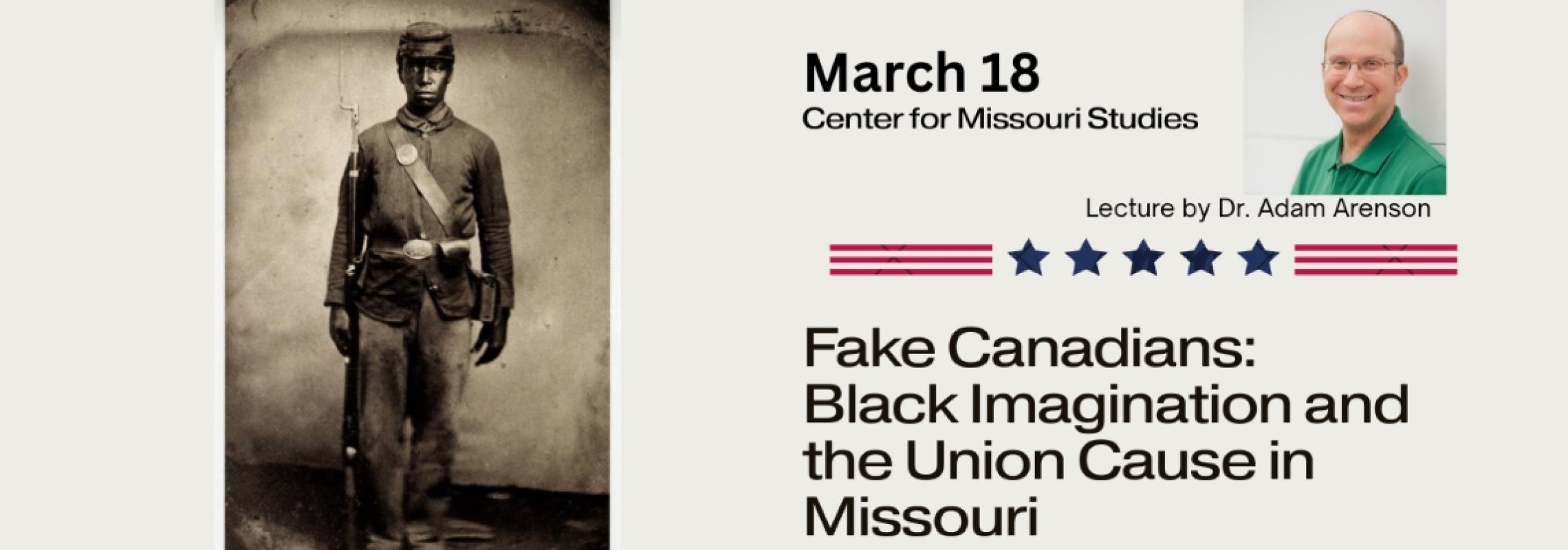
During the Civil War, Black men who gathered to enlist at Benton Barracks in St. Louis listed birthplaces in Canada, Jamaica, and England. While more than 600 Black Canadians did serve, those men enlisting in St. Louis were not in fact coming from abroad. They were Black Missourians, seeking to join the Union cause and hide from their family or their enslavers—especially when their enslavers actually supported the Union. As part of the African American Experience in Missouri Lecture, Dr. Adam Arenson will describe what the military, census, and pension files reveal about these fake Canadians, who knew their secrets and when, and what their efforts tell us about the imaginative work of the enslaved and newly freed, and their efforts to support the United States.
The public is invited to this free lecture sponsored by the State Historical Society of Missouri, University of Missouri Kinder Institute on Constitutional Democracy, and the MU History Department. Please join us for the reception at 5 p.m. Dr. Arenson's lecture begins at 5:30 p.m. inside Cook Hall.
About the Presenter: Dr. Adam Arenson is Phi Beta Kappa graduate of Harvard University, and he earned his Ph.D. in History at Yale University. He has held professorships of history and urban studies in Texas and New York, and he has been a department chair. Dr. Arenson has written for The New York Times, The Atlantic, and The Washington Post, among other outlets, and he is the author of two award-winning books and two edited volumes. He currently teaches in the Honors Program at Iona University.
Dr. Arenson’s first book, The Great Heart of the Republic: St. Louis and the Cultural Civil War (Harvard University Press, 2011; paperback, University of Missouri Press, 2015), argued that the conflicts of the Civil War Era are best understood as results of a three-way debate over Manifest Destiny and the extent of slave society among northern, southern, and western advocates, with all sides shaping the culture and institutions of St. Louis. It won the Phi Alpha Theta-Charles Redd Center for Western Studies award, and it was named a Best Book of 2011 by the St. Louis Post-Dispatch.
His current research, After the Underground Railroad, is a political, economic, and family history of the collective experience of African North Americans crossing the U.S.-Canada border, mostly moving south, during and after the Civil War. It is under contract with the University of California Press.